Reads your piece
It analyses the notes, key signature, recurring patterns and the reach your piece demands — the same MusicXML you practise from.
Most apps hand everyone the same drills. Prepare reads the score you imported and writes a practice set for that piece — the scales in its key, and short drills lifted from its own hardest bars. The warm-up a good teacher would write out, from the music in front of you.
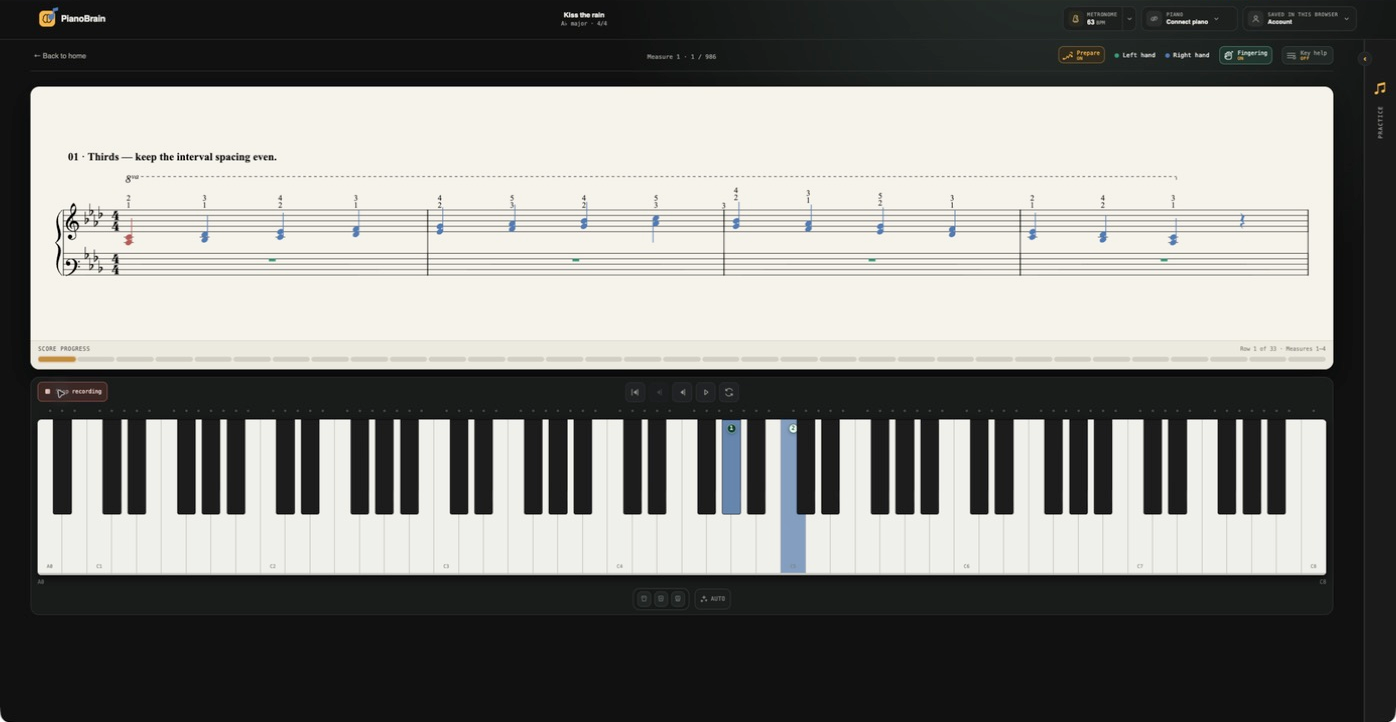
It analyses the notes, key signature, recurring patterns and the reach your piece demands — the same MusicXML you practise from.
It scans for scale runs, broken chords and arpeggios, repeated figures, tricky fingerings, chord changes, leaps and dense, fast passages.
Each becomes a short four-bar loop made from your piece's own notes, with a plain instruction for what to work on.
When a bar keeps tripping you up, PianoBrain takes the hardest occurrence and loops it as a four-bar exercise built from those exact notes — not a generic étude. Each one comes with a single, plain instruction, the kind a teacher writes in the margin.
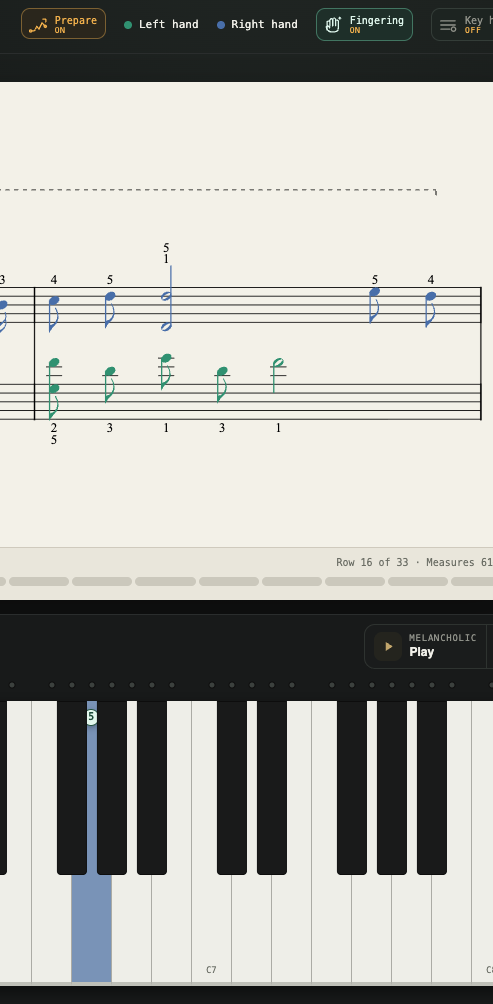

Alongside the drills, Prepare lays in the fundamentals in your piece’s own key — so the scales and shapes you practise are the ones the music actually uses. Ordered easiest-first, so the warm-up genuinely warms you up.
No exercise stretches wider than the piece itself asks for, and the whole set is ordered by an ergonomic difficulty model — finger transitions, chord spans, awkward thumb-and-pinky moments on the black keys, leaps and speed. The hard things come after the easy ones, on purpose.
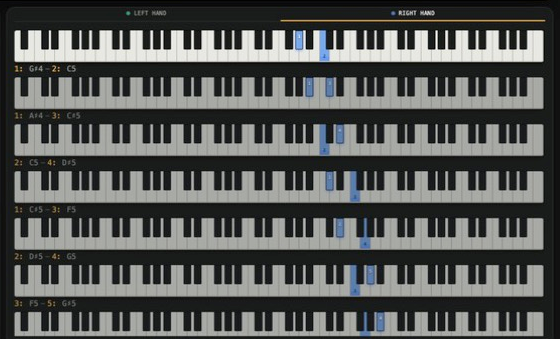
Prepare is deterministic. The exercises are derived by analysing your MusicXML — the scales in its key, the patterns in its bars — not written by a language model guessing at your music. Fingering suggestions are the one place a trained model helps, and only when your score doesn’t already specify them. See how a session works ↗
MIDI keyboard
Pair your piano in Bluetooth settings, then connect it here